

Presentations from the ESA Conference “Technology, Artificial Intelligence and Education: Towards the Future of Learning”
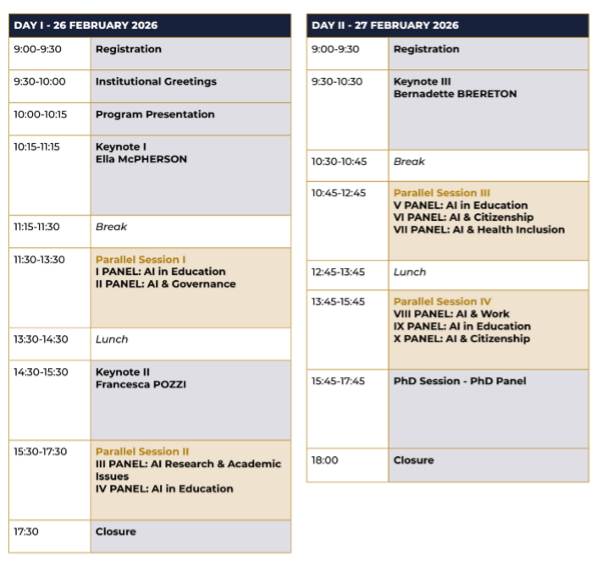
26 February 2026 – Session I
KEYNOTE SPEAKER
Generative AI and the Social of Scholarship – E. McPherson, Queen’s College, Cambridge
Panel I – AI in Education
Chair: M. FRANCESCHELLI, UCL Social Research Institute
Discussant: S. CAPOGNA, Link Campus University
- When Machines Learn, Humans Must Learn Better: AI Literacy and the Future of Education – A. Cardinale, M. Nocenzi, Sapienza University
- Tail Sensitivity of LLM Outputs Under Prompt Perturbations – A. Novak, M. Kovačić, Zagreb School of Economics and Management
- Formative Feedback Through Large Language Models on Narrative and Expository Texts in German: Strengths, Limits, and Prompt Design – C. Peschak, S. P. Harmer, University College of Teacher Education Vienna
- The Sonification of Chemical Data as a Tool for STEM Education and Inclusivity – G. Tranfo, AIDII
Panel II – AI & Governance
Chair: M. ANGELINI, Link Campus University
Discussant: F. GRECO, University of Udine
- Exploring Students’ Ethical and Privacy Concerns in the Adoption of Artificial Intelligence – A. Mortara, R. Scramaglia, IULM University, Milan
- Navigating Regulatory Convergence: Strategies for Corporate Compliance with GDPR and the EU Artificial Intelligence Act – F. De Stefani, Link Campus University
- Digital Law, Data Governance and Artificial Intelligence – F. Faini, Pegaso Telematic University
- Innovating Museum Accessibility Through Cross-Sector Partnerships: The SCAAUT Business Model – N. Cipullo, Link Campus University
- Objective and Subjective Culture in Platform Society – T. Censi, Leoniano Theological Institute
- Towards Inclusive AI: Regulatory and Ethical Challenges – M. Forleo, L. Evangelista, C. Fonzo, INAPP
KEYNOTE SPEAKER
When Ai Meets Education: Navigating Promise, Peril, and Systemic Change – F. Pozzi, Institute for Educational Technologies, National Research Council
Panel III – AI Research and Academic Issues
Chair: V. FEDELE, Link Campus University
Discussant: P. C. GRIMALDI, Link Campus University
- AI, Microlearning, and the Social Fabric of Lifelong Learning: Opportunities and Inequalities in the Italian Context – A. Pedone, INAPP
- Digital Inclusion In The Age Of AI: Examining Approaches To Ensure Educational Equity For Students From Different Socioeconomic Backgrounds – F. Campitelli, N. Strizzolo, University of Teramo
- AI Play and Co-Creating Board Games with Generative Artificial Intelligence – G. Conti, University of Modena and Reggio Emilia
- Learning With Ai, Learning About Ai: Evidence From University Teaching And Employer Engagement – M. Ruzzeddu, University of Niccolò Cusano
- AI, Qualitative Inquiry, and Analytical Labor: Insight from MAXQDA – P. Binder, Institute of Philosophy and Sociology, Polish Academy of Sciences
Panel IV – AI in Education
Chair: M. R. RE, Link Campus University
Discussant: S. ROMITI, INVALSI
- Affective Algoagents and the Making of the Social Self in algomorphic societes – E. Grassi, San Raffaele Open University of Rome
- AI-Driven Digital Twin with Agent- Based Modeling for Behavioural and Learning Analysis in Informatics Education – G. Vonitsanos, I. Moustaka, Hellenic Open University
- Accessibility in Digital Learning: Opportunities and Challenges – E. Sciarretta, E. Greco, Link Campus University
- Teenagers and digital technologies. A Comparison Among The Perspectives Of High School Students, Teachers And School Heads – A. F. Canta, A.Mattozzi, L. Tonolli, V. Konidari, Polytechnic of Turin
27 February 2026 – Session II
KEYNOTE SPEAKER
Transforming Gender Equality and Inclusion in Higher Education in Ireland – B. Brereton, Dundalk Institute of Technology
Panel V – AI in Education
Chair: A. CAROSELLI, University of Milan
Discussant: I. CORTONI, Sapienza University
- Playing The City: Gamified Urban Participation As A Model For Citizen Science-Based Learning – I. Iannuzzi, M. Sessa, Unitelma Sapienza University
- Critical Thinking, Decision Fatigue, And Cognitive Disengagement In Ai-Mediated Learning: A Crosssectional Study On Students’ Use Of Generative Tools – V. Donadel, M. Zuin, Luiss University
- Inequalities In The Development Of Artificial Intelligence And Their Consequences For Inequality In Education – U. Šuvaković, University of Belgrade – Faculty of Education, Department for Philosophy and Social Sciences
- Exploring Socio-Cultural And Ethical Dimensions Of Ai Adoption In Academic Practices – M. C. De Angelis, Link Campus University
Panel VI – AI and People and Citizenship
Chair: A. DE FEO, Roma Tre University
Discussant: D. POLIANDRI, INVALSI
- Community Engagement Through Citizen Science: A Participatory Experience In Chiavari (Genoa, Italy) To Address Climate Change And Its Impacts – P. Salvati, CNR – IRPI
- The European Climate-Neutral City As A Sociotechnical Imaginary. Policy, Technology, And Imagination In Urban Climate Change Mitigation – C. Bracchi, Catholic University of the Sacred Heart
- Theatre, Statistics and Critical Pedagogy Towards Data Literacy in the Algorithmic Society – E. Sorba, E. Risi, IULM University, Milan
- AI-Driven Personalized Learning and the Future of Education: a critical sociological and STS perspective – G. Senatore, Sapienza University
- AI For Everyone: An Inclusive And Gentle Method For An In-Depth Introduction To AI – P. Ferrante, E. Sorrentino, E. Lo Scrudato, G.Tranfo, INAIL
Panel VII – AI and Health Inclusion
Chair: R. GURASHI, Link Campus University
Discussant: B. MORSELLO, Padua University
- Artificial Intelligence and the Limits of Knowledge – M. Ciampi, T. Marci, Sapienza University
- Rethinking Learning Futures: Sociological Perspectives On Ai, Cognitive Adaptivity And Educational Transformations – S. Pellegrini, R. Mancini, R. Sebastiani, Link Campus University
- The Use Of Artificial Intelligence In Inclusive Learning: Field Trials – B. Letteri, University of Sassari
- Social Empathetic Cognitive Robotics For Autism (SECRA): A Protocol Design Involving Parents Of Children With Autism – T. Caprì, F. P. Sortolano, G. Todaro, P. Chilà, F. Marino, Link Campus University
Panel VIII – AI & Work
Chair: E. PROIETTI, Roma Tre University
Discussant: L. DE VITA, Sapienza University
- The Impact of Artificial Intelligence on Work and Lifelong Learning – A. Bianco, “G. d’Annunzio” University of Chieti-Pescara
- Educating For Artificial Intelligence: Learning Pathways, Gender, And Emerging Digital Inequalities – F. Fortunato, S. Muccio, IULM University Milan
- A Multimodal AI-Based Virtual Assistant For Adaptive Ergonomic Training In Hybrid Work Environments– E. Pietrafesa, G. Simoncelli, L. De Angelis, A. Martini, S. Anastasi, C. La Gioia, INAIL
- Digitalising Care, Reconfiguring Welfare: The CESU+ Model As A Digital Public Platform For Labour Formalisation – M. De Minicis, INAPP
Panel IX – AI in Education
Chair: C. FONZO, INAPP
Discussant: M. FREDDANO, INVALSI
- Peer Review As A Collaborative Methodology For Quality And Learning In Vocational Education – L. Evangelista, C. Fonzo, INAPP
- Developing Teachers’ Competences For Inclusive Gifted Education: The Gifted Game-Based Ecosystem As A Digital Training Environment – R. Renati, Link Campus University
- Evaluating E-Learning Platforms For Ai-Enhanced Project-Based Learning: Case Of Lithuanian Primary Education – K. Kesylė, J. Melnikova, G. Šmitienė, A. Batuchina, A. Norvilienė, I. Rupšienė, N. Strazdienė, D. Baziukė, E. Brazauskienė, Klaipeda University
- Strategies For Ai Integration For Personalized Student’s Study In Higher Education Institutions – E. Župerkienė, H. Mishenina, S. Tarasenko, Klaipeda University
Panel X – AI and People and Citizenship
Chair: M. SESSA, CNR – IRPI
Discussant: P. SALVATI, CNR – IRPI
- For A Renewal of The Sociology Of Emotions. On The Relationship Between Fear and Artificial Intelligence – E. Susca, IULM University, Milan
- Living With The Algorithm: Bonds, Ethics And Care In Smart Homes – R. Gurashi, Link Campus University
- For Effective Citizen Science: The Case Of Desenzano Del Garda – I. Beretta, A. Molinari
- Between Dependence and Risk: Young People’s Digital Behaviours and Forms of Vulnerability – M. Bonanni, O. Giancola, B. Pasanisi, Sapienza University
PhD Panel
Chair: F. CAGNOLI, PhD Representative, Board Member, ESA RN24
Discussant: M. RUZZEDDU, Unicusano
- Technicist Culture And Forms Of Knowledge: The Case Of Digital Competencies – C. Petrocchi
- Ai Between The Risk Society And The Algorithmic Society: The Case Of Education – N. Santone
- Algorithmic Affect And Learning: Impacts Of Ai On The Affective And Social Dimensions In Educational Spaces – N. Pietropaolo, F. Pietroniro
- Work-Related Stress And Hybrid Work: The New Inail 2025 Methodology Between Soft Law And Prevention Obligations Under Legislative Decree 81/2008 – F. M. Spanò
- Training And Digital Governance In The Italian “Uffici Di Esecuzione Penale Esterna” – J. Malponte